
Have you ever put on a pair of jeans that fit perfectly a year ago and suddenly noticed they're tight around the waist?
Not the hips. Not the thighs. The waist.
For many women, this happens during perimenopause and menopause, and it can feel incredibly frustrating. You're still exercising. You're trying to eat well. Maybe you're even eating less than you used to. Yet your body shape seems to be changing anyway.
The first instinct is usually to double down. More cardio. Less food. More workouts.
Unfortunately, that's often the exact opposite of what your body needs.
Now, a calorie deficit is still required to lose body fat, but how you create that deficit matters. Constantly eating less and exercising more can leave you under-fuelled, making it harder to preserve muscle, recover well, manage hunger, and stay consistent over the long term.
What many women don't realize is that midlife brings hormonal changes that affect where your body stores fat, how easily you build muscle, and how your metabolism responds to stress. Understanding those changes can help you stop fighting your body and start working with it.
Not All Body Fat Is the Same
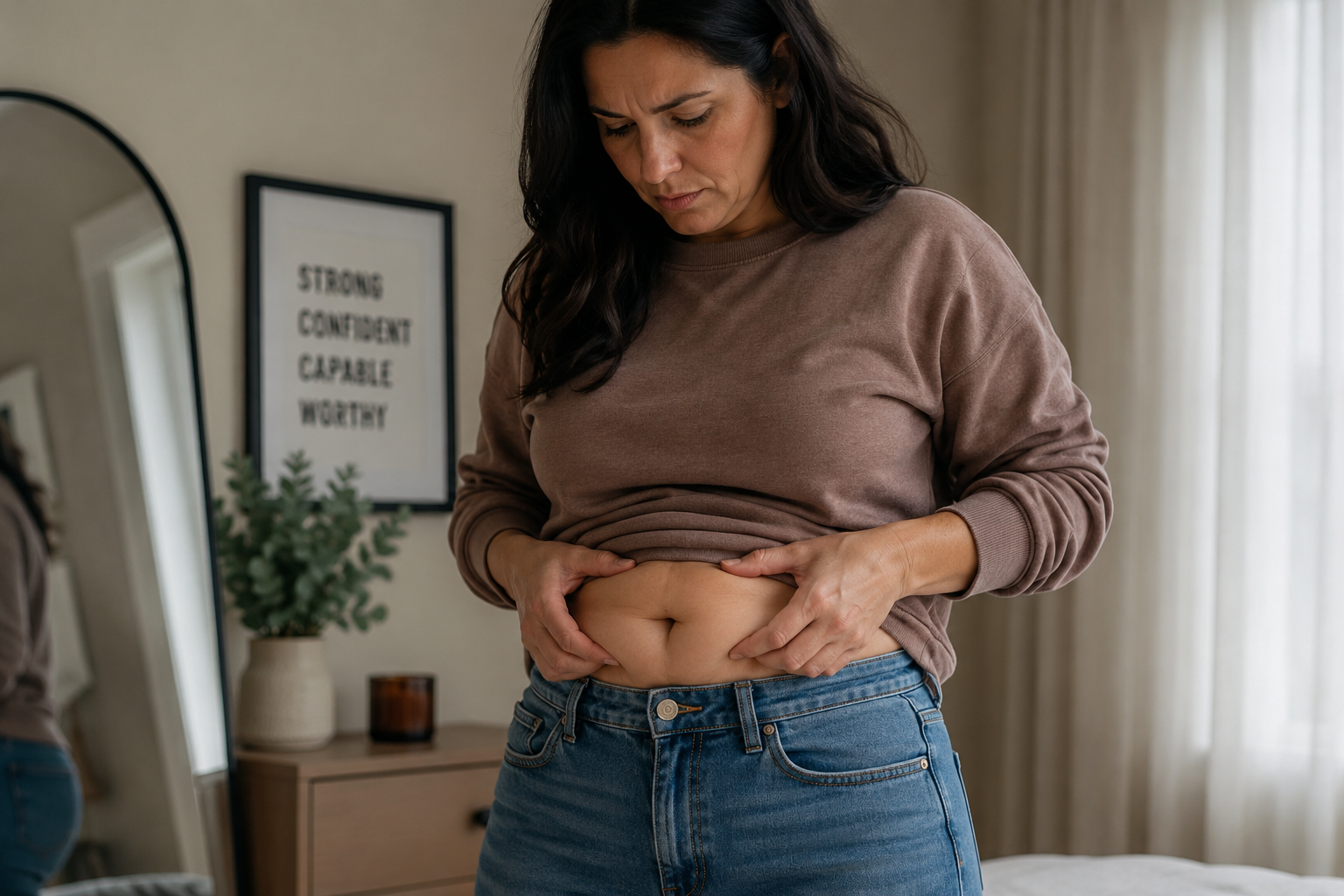
When most people think about body fat, they think it's all the same. But there are actually two different types that matter in midlife.
Subcutaneous fat is the fat that sits just under the skin. It's the fat you can pinch on your arms, your thighs, hips, or stomach.
Visceral fat sits deeper inside the abdomen around your organs. You can't pinch it, and it's often responsible for that thicker, firmer midsection many women notice during menopause.
The reason this matters is because visceral fat isn't just sitting there. It's biologically active and can affect things like blood sugar regulation, cholesterol levels, inflammation, and overall health.
While neither type of fat appears overnight, many women notice a shift during midlife where fat that once settled around the hips and thighs starts moving toward the abdomen.
That's where hormones come into the picture.
Why Your Belly Changes During Midlife
One of estrogen's roles is helping decide where your body stores fat. During your reproductive years, it encourages more fat to be stored around the hips, thighs, and glutes rather than around the abdomen.
As estrogen begins to decline during perimenopause and menopause, fat distribution often begins to shift. At the same time, many women also experience an increase in visceral fat, which is why changes around the waist become so common during midlife.
At the same time, another challenge is happening. We're naturally losing muscle as we age.
Unless you're actively strength training, muscle mass slowly declines over time. Less muscle means a slower metabolism, reduced insulin sensitivity, and fewer calories burned throughout the day.
Then add in the reality of midlife:
Busy careers
Aging parents
Adult children
Less sleep
More stress
Years of dieting
It's no wonder so many women feel like their body has a mind of its own.
The belly fat isn't showing up because you've suddenly become lazy or lost all your discipline. Your body is simply responding to a different set of hormonal and lifestyle circumstances than it was 20 years ago.
Why Eating Less Usually Doesn't Fix It
This is where I see so many women get stuck. They notice weight gain around their midsection and immediately start cutting calories.
Maybe they skip breakfast.
Maybe they eat salads all day.
Maybe they add another cardio class.
For a short period of time, that might seem like the right move. But when you consistently under-eat, your body doesn't suddenly become a fat-burning machine.
Instead, you often end up:
Feeling exhausted
Struggling with cravings
Recovering poorly from workouts
Losing muscle
Feeling hungry all the time
Thinking about food constantly
I've worked with women who were eating the typical 1,200 calories diet, exercising five or six times a week, and still feeling frustrated with their progress.
There was definitely no lack of effort. The issue was that they were using strategies that no longer matched what their body needed.
The Real Game Changer: Building Muscle
If there is one thing I wish more women understood about midlife fat loss, it's this:
Muscle is your friend.
The more muscle you maintain, the better your body becomes at using energy (calories), regulating blood sugar, and supporting a healthy metabolism.
This is why strength training becomes so important after 40. Not because we want to become bodybuilders but because muscle is one of the few things we can actively control as we age.
Protein Matters More Than Most Women Realize
Strength training and protein go hand in hand. If you're asking your body to build or maintain muscle, you need to provide the building blocks to make that happen.
That's where protein comes in.
One of the easiest habits I encourage women to focus on is getting protein at every meal. For many women, aiming for roughly 25 to 35 grams of protein per meal is a great place to start.
Protein helps:
Support muscle growth and recovery
Keep you fuller for longer
Stabilize energy levels
Reduce mindless snacking
Preserve muscle while losing body fat
It doesn't have to be perfect but is should become a priority.
Don't Ignore Sleep, Stress, and Daily Movement
I wish I could tell you that strength training and protein are the entire solution.
They're not.
If you're sleeping four or five hours a night, constantly stressed, and spending most of your day sitting, your body is going to have a much harder time making progress.
A few things that make midlife belly fat more stubborn:
Poor sleep
Chronic stress
Low daily movement
Losing muscle over time
Not eating enough protein
Relying on cardio while avoiding strength training
This is one reason I'm always talking about walking.
It's isn't flashy and it doesn't burn hundreds of calories in 20 minutes. But it does help manage stress, supports recovery, improves blood sugar control, and keeps you moving without adding more stress to your system.
Sometimes the basics are still the most powerful tools.
What I See With Clients All The Time
Women often come to me convinced they need to work harder but in reality, most of them need a better strategy.
I recently worked with a woman who was running multiple days a week and eating very little because she thought that was the answer.
Her energy was low.
Her waistline was growing.
She felt defeated.
Instead of adding more exercise, we actually did less. We introduced a structured strength training program, increased her protein, and improved her overall nutrition.
Within a few months, her clothes started to fit better, her energy improved, and she felt stronger than she had in years.
She didn't need more restriction, she needed a plan that worked with her changing body.
The Bottom Line
If you're noticing more weight around your midsection in your 40s and 50s, you're not imagining it. Hormonal changes, muscle loss, stress, sleep, and lifestyle factors all play a role.
The good news is that you don't need to spend hours doing cardio or survive on salads to make progress.
Focus on the things that move the needle:
Strength train consistently
Prioritize protein
Walk daily
Improve sleep
Manage stress
Stay patient
Midlife isn't the end of feeling strong, confident, and comfortable in your body. It simply requires a different approach than the one that worked in your 20s. And honestly, that's okay.
Our goal in midlife isn't to go back to who we were 20 years ago, it's to build the strongest, healthiest version of ourselves now.
If you're tired of trying to figure this all out on your own, I'd love to help. Through my Strong & Balanced Coaching, we'll create a realistic plan that focuses on strength, nutrition, and the habits that actually move the needle.