
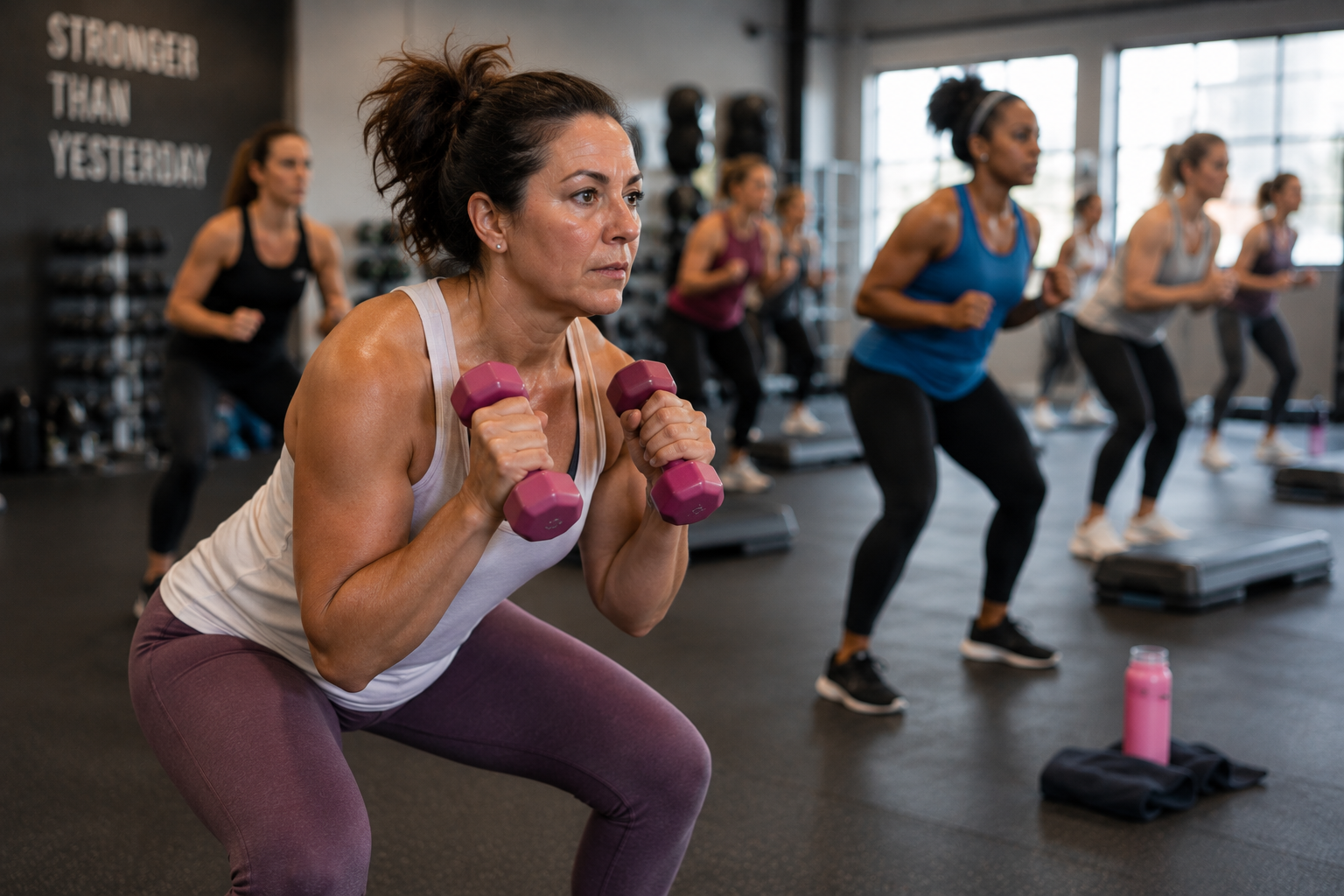
Look, I get it. You are working your butt off. You are showing up, squeezing in workouts between work and family, and leaving yourself completely exhausted. But if you look at your body, your strength, and your clothes over the last six months, nothing is actually changing.
It is incredibly frustrating to feel like you are doing everything right while the scale won't budge, your muscles feel softer, and your joints just ache.
The stuff that worked for us in our twenties and thirties simply does not work anymore. Midlife changes the rules. When our estrogen levels start fluctuating, our bodies change how they handle stress, how they build muscle, and how they burn energy. Moving your body is great for your mental health, but if you want to actually change your body composition and wake up your metabolism, running yourself into the ground with random exercises is keeping you stuck.
Exhaustion Does Not Equal Progress
We have been conditioned to think that a workout only counts if we are dripping sweat and completely wrecked on the floor. Because of that, it is easy to fall into the habit of chasing variety. You do a spin class one day, a streaming pilates workout the next, and then a random circuit you found on social media on Friday.
While that keeps you from getting bored, it completely lacks a purpose. Your body adapts to the specific demands you place on it. When you change those demands every single day, your body never gets a clear signal to do anything meaningful. It just tries to survive the stress you threw at it, without actually building new muscle or boosting your metabolic rate.
In our forties and fifties, muscle is our ultimate fountain of youth. It is the main engine of our metabolism and the foundation that keeps our joints from aching. To build or even keep that muscle during perimenopause and menopause, we have to give our body a clear, consistent reason to adapt. Random workouts create fatigue, not change. We need to stop just working out and start intentionally training.
The Secret is Just Doing the Same Boring Stuff Better
Training means having a plan and sticking to it, even when it feels repetitive. The absolute baseline of changing your body right now is a concept called progressive overload. Don't let the fitness terminology throw you off; it just means gradually making your muscles work a little harder over time so they are forced to get stronger.
When you follow a structured lifting plan, you do not change your exercises every week. Instead, you perform the exact same foundational movements - like squats, hinges, pushes, and pulls - for several weeks in a row.
Progressive Overload = Gradually increasing weight, reps, or improving form on the same exercises over time.
To make your muscles change, you have to challenge them beyond what they are used to. You do this by making tiny, measurable changes to your routine each week.
Pick up heavier weights: Move from the 10-pound dumbbells to the 12-pounders.
Do more repetitions: Perform one or two more reps with the same weight you used last week.
Slow down: Control the weight better through the full movement rather than using momentum.
Rest with purpose: Take a real break between sets so you can lift heavy again on the next round.
When you repeat the same movements week after week, you can actually track this. If you lift the twelve-pound dumbbells for eight reps this week, and then nine reps next week, you did it. You achieved progressive overload. Your body has no choice but to adapt by tightening and building muscle tissue. If you change your workout every single day, you have no baseline to improve upon.
Muscle Alone Won't Melt the Fat Away
Now, we need to talk about the missing piece of the puzzle. Yes, building muscle gives you the metabolic engine you need, but strength training alone is not going to magically melt the fat off your body. You cannot out-squat a bad diet, especially in midlife when our bodies are less forgiving of nutritional guesswork.
If you are lifting heavy but still eating like you did ten years ago, or if you are eating "clean" but have no real clue how many total calories or macros you are consuming, you are going to stay stuck. Building the muscle happens in the gym, but uncovering that muscle happens in the kitchen.
If you are serious about seeing the scale move and changing your body composition, you have to stop guessing with your nutrition. Real progress happens when you combine structured training with precise, data-driven nutrition. To help you fix this side of the equation, I created a FREE Macro Nutrition guide you can grab right here.
Why Structure Beats Variety Every Time
Following a consistent plan might sound boring compared to a flashy new fitness class, but structure is exactly what our hormones need. When you know exactly what exercises you are doing before you even step into the room, you eliminate the decision fatigue that makes you want to skip workouts entirely.
A structured plan also protects your joints and your nervous system. Random workouts often involve high-volume, high-impact movements that pound your joints without giving you enough recovery time. A solid strength program does the opposite. It prioritizes recovery so you stimulate your muscles without chronically spiking your cortisol levels, which is a major culprit behind stubborn midsection fat and terrible sleep.
There is a very clear pattern with women who trade the random cardio circuits for structured lifting: their nagging knee and lower back pain starts to disappear. Strength training builds up your tendons, ligaments, and bones right along with your muscles. That structural support is exactly what we need to stay vibrant, active, and injury-free through menopause and beyond.
Get a coach and make a Plan
It is incredibly hard to design and execute a structured plan all by yourself. When you try to be your own trainer, it is easy to default to the exercises you like and skip the ones you actually need. You end up standing there questioning whether you are lifting heavy enough, or if your form is right, which leads to frustration and stalled progress.
This is where professional guidance changes everything. A dedicated coach takes the guesswork completely out of the equation. You no longer have to spend hours wondering what workout to do or whether your efforts are actually moving the needle.
A coach provides an objective set of eyes to ensure you are moving safely and effectively. More importantly, an online coach holds you accountable to the plan on the days when your motivation is completely gone. Having a customized roadmap tailored to your specific midlife biology means every single ounce of effort you put in yields a direct reward.
Stop Exercising and Start Training
If you want different results, you have to stop treating your fitness like a series of disconnected, random events. Your body is incredibly smart, and it requires a clear, consistent message to change.
Ditch the mindset that a workout has to leave you exhausted to be effective. Focus on mastering the basics, tracking your weights, and giving your body a structured reason to grow stronger. Our midlife years are an incredible opportunity to build the strongest, most resilient version of ourselves, but we need the right tools and a solid blueprint to get there.
If you are ready to stop guessing, stop wasting time on random workouts, and finally see the reward for your hard work, let's build your custom plan together.
My 1:1 online coaching program, Strong & Balanced Coaching, gives you the exact strength, macro nutrition, and mindset roadmap you need to build muscle and feel confident in your skin.